- Your cart is empty
- Continue shopping
-
Dr Hoffman
- Posted on
- Categories:Uncategorized
- 0 comments
Scientific integrity is built on the foundation of a verifiable supply chain, where a purity of >99% is a baseline requirement rather than a luxury. You likely understand the frustration caused by batch-to-batch inconsistency or ambiguous purity claims that jeopardize months of laboratory work. When a study relies on the precision of research peptides, even a minor deviation in chemical integrity can lead to non-reproducible data and skewed results. Since establishing our operations in 2012, Nexa Peptide Store has observed how the global peptide therapeutics market, valued at up to $163.98 billion in 2026, demands increasingly rigorous quality control protocols.
This comprehensive guide will help you master the technical and logistical criteria for selecting premium-grade compounds to ensure the total integrity of your investigations. We’ll detail the essential laboratory standards, such as USP chapters 1503 and 1504, while explaining how the April 2026 FDA regulatory shifts affect your procurement strategy. You’ll gain a clear framework for verifying third-party HPLC and MS data, ensuring your laboratory receives only the highest-quality materials dispatched through reliable, temperature-controlled logistics. Our 14 years of pioneering excellence provides the context you need to establish a dependable supplier relationship and achieve reproducible research data.
Key Takeaways
- Learn to distinguish between standard-grade compounds and high-purity materials by applying USP quality attributes to your procurement process.
- Understand how High-Performance Liquid Chromatography isolates target molecules to achieve a verified purity of >99% for your research peptides.
- Master a framework for evaluating supplier credibility by prioritizing “EST 2012” longevity and verifying third-party analytical testing documentation.
- Implement precise laboratory protocols for handling and storage, ensuring lyophilized vials remain stable through strict temperature-controlled environments.
- Secure the integrity of your scientific investigations by establishing a reliable supply chain built on technical transparency and 14 years of pioneering excellence.
Research Peptides: Defining Quality Standards for Scientific Integrity
Scientific investigation demands precision at the molecular level. Research peptides are defined as short chains of amino acids, typically consisting of 2 to 50 residues, that are synthetically produced for in-vitro laboratory experimentation. These compounds serve as essential tools for mapping biological pathways and understanding cellular interactions. It is essential to recognize that these research-grade materials are distinct from therapeutic agents intended for clinical use. Our products are exclusively designated under the Research Use Only (RUO) mandate. This classification is a core pillar of laboratory safety and institutional compliance that ensures these substances are handled within the appropriate scientific framework. As the global peptide therapeutics market is estimated to reach $163.98 billion in 2026, the demand for rigorous quality control has never been higher.
The Role of Peptides in Modern Scientific Discovery
Peptides play a transformative role in current research, particularly in metabolic, neurological, and cellular signaling studies. Modern Peptide synthesis methods allow for the creation of highly specific analogs that mirror endogenous signaling molecules. By utilizing synthetic analogs, researchers can conduct targeted investigations into biological pathways without the confounding variables found in natural extracts. For instance, the study of BPC-157 5mg or Tirzepatide 10mg in controlled environments allows for the observation of specific receptor affinities and metabolic responses. Since 2012, Nexa Peptide Store has supported these investigations by providing consistent access to a wide range of compounds, including GHK-Cu 50mg and Semaglutide 5mg, which are fundamental to modern biochemical assays.
Why Purity Standards Matter for Your Data
The integrity of peer-reviewed research depends entirely on the quality of the starting materials. Impurities, such as truncated sequences, salts, or residual solvents, can introduce significant noise into cellular assays and in vivo models, leading to non-reproducible data. In the scientific community, a purity of >99% is established as the gold standard for high-stakes research. Peptide purity is defined as the mass fraction of the target peptide relative to the total mass of all peptide-related solids as verified by High-Performance Liquid Chromatography (HPLC). At Nexa Peptide Store, our commitment to 14 years of pioneering excellence means we don’t settle for less than this benchmark. Every batch of research peptides is strictly manufactured in a state-of-the-art laboratory. This discipline ensures that your research data remains accurate and your scientific reputation remains untarnished. We prioritize these laboratory standards to provide the commercial reliability your institution requires for successful discovery.
The Analytical Science Behind >99% Peptide Purity
Solid-phase peptide synthesis (SPPS) serves as the industrial standard for manufacturing research peptides. During this process, amino acids are added sequentially to a resin substrate to build the desired chain. While highly efficient, SPPS can introduce impurities through incomplete coupling or side-chain reactions. These synthesis byproducts must be meticulously removed to ensure the chemical integrity of the final compound. Since 2012, Nexa Peptide Store has maintained a disciplined approach to these manufacturing hurdles, ensuring that every batch meets our rigorous internal standards.
Isolation of the target molecule is achieved through High-Performance Liquid Chromatography (HPLC). This technique utilizes high pressure to force the crude peptide mixture through a specialized column. Different molecules travel at varying speeds based on their chemical affinity for the column material, allowing the target peptide to be isolated with surgical precision. While HPLC confirms the purity of the substance, Mass Spectrometry (MS) is required to verify its identity. MS measures the mass-to-charge ratio of the ions, allowing researchers to compare the actual molecular weight against the theoretical molecular weight. This dual-verification process ensures the compound is exactly what the label claims it to be.
To eliminate supplier bias, Nexa Peptide Store utilizes third-party verified testing for its entire inventory. This ensures that our quality claims are backed by objective, independent data rather than internal estimates. You can review our third-party verified reports to confirm the high-purity standards of our products before beginning your study. Our 14 years of pioneering excellence is built on this transparency, providing the commercial reliability that global research institutions expect.
Interpreting HPLC Chromatograms and MS Reports
A professional analytical report should display a single, sharp peak on the HPLC chromatogram. The “peak area percentage” represents the purity level; for our products, this must exceed 99%. Red flags in these reports include wide peaks or multiple significant peaks, which indicate degradation or synthesis errors. In the MS report, the actual weight should match the theoretical weight within a narrow margin. Reports that lack batch numbers or specific dates are insufficient for peer-reviewed research and should be avoided. For a deeper technical framework on interpreting batch-specific HPLC and MS documentation, our guide on verified peptides and lab purity standards provides the rigorous methodology your investigations require.
Lyophilization: Ensuring Long-Term Chemical Stability
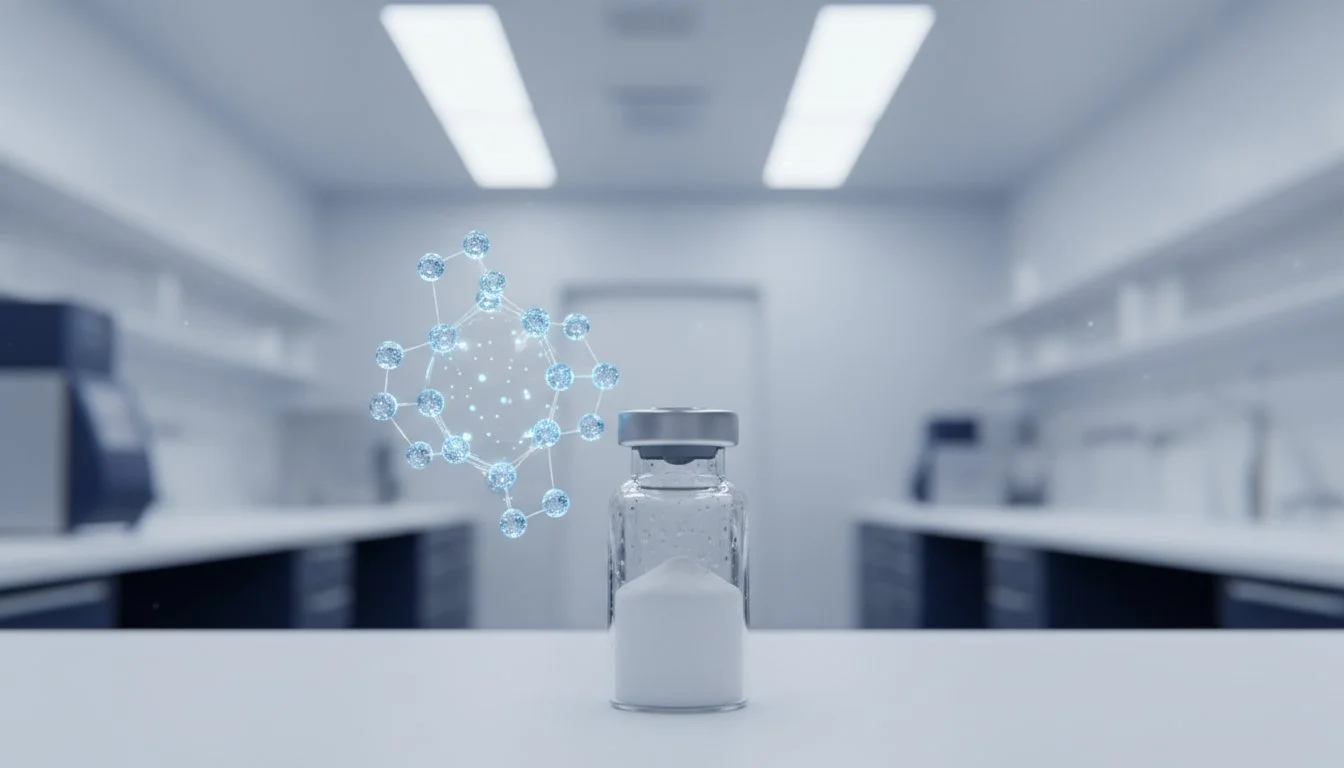
Lyophilization, or freeze-drying, is the final manufacturing stage that removes solvents through sublimation in a vacuum. This process preserves the primary structure of the research peptides while significantly extending their shelf life. Lyophilized powder is superior to liquid solutions for international shipping because it’s far more resistant to temperature fluctuations during transit. By removing water, lyophilization prevents hydrolysis and enzymatic degradation, ensuring the peptide remains stable when stored at -20°C. This state-of-the-art preservation method is why we can confidently dispatch our products to laboratories worldwide without compromising their integrity.

Supplier Evaluation: Identifying Verified Research Peptide Sources
Selecting a supplier is a foundational decision that dictates the trajectory of your scientific investigation. In an industry where quality varies significantly, institutional credibility serves as the primary safeguard for your data. Longevity is a critical marker of this reliability; Nexa Peptide Store has maintained its position as an industry leader since being established in 2012. Our 14 years of pioneering excellence provides a track record that newer, unverified vendors cannot replicate. When you evaluate a source for research peptides, you aren’t just buying a chemical; you’re investing in a verified supply chain that must withstand the scrutiny of peer review. This commitment to data integrity is also found in specialized diagnostic services like Dyvine Medical & Wellness, which applies rigorous standards to DNA testing and wellness panels.
A supplier’s technical knowledge is often revealed through their customer support interactions. Professional vendors employ staff who understand the biochemical nuances of products like IGF-1 LR3 1mg or MOTS-c 10mg rather than relying on generic sales scripts. If a support team cannot discuss the specifics of peptide stability or reconstitution protocols, they likely lack oversight of the manufacturing process. Furthermore, logistics must be as disciplined as the synthesis itself. Reliable providers use vacuum sealing and temperature-controlled packaging to protect the molecular integrity of the compounds during transit. At Nexa Peptide Store, every order is dispatched with a focus on logistical efficiency to ensure that the chemical structure remains intact from our laboratory to yours.
Red Flags in the Research Chemical Market
The most significant red flag is the marketing of peptides for human consumption. This practice is strictly prohibited and indicates a complete lack of regulatory compliance. Any vendor suggesting medical use or offering prescriptions is operating outside the legal framework for research chemicals, which creates substantial legal and safety risks for your institution. Pricing also serves as a diagnostic tool; the cost of high-purity synthesis and third-party verification is substantial. If a supplier’s pricing for Tirzepatide 10mg or Retatrutide 10mg is 40% lower than the market average, it’s likely that they’ve bypassed essential purification steps like HPLC. Anonymous ownership and the absence of batch-specific COAs are additional signs that a vendor doesn’t prioritize transparency or scientific integrity. Researchers seeking to understand precisely what distinguishes genuinely verified peptides from mislabeled or degraded compounds will find that batch-specific documentation dated within the last 30 days is a non-negotiable standard.
Verification Checklist for New Research Partnerships
Before committing to a long-term supplier relationship, utilize this verification checklist to ensure they meet professional standards:
- Batch-Specific Data: Does the supplier provide unique HPLC and MS reports for the specific batch you’re receiving?
- RUO Compliance: Is there a clearly defined “Research Use Only” policy integrated into their terms of service?
- Institutional History: Can the vendor demonstrate a history of serving established universities and research organizations since their inception?
- Analytical Transparency: Are the third-party labs used for testing reputable and independent of the supplier’s ownership?
By strictly adhering to these criteria, you ensure that your research peptides are sourced from a partner that values data accuracy as much as you do. Our commitment to >99% purity and disciplined manufacturing ensures that your laboratory results are reproducible and scientifically sound.
Laboratory Best Practices: Handling and Storage for Stability
Maintaining the chemical integrity of research peptides once they leave our temperature-controlled facility requires a disciplined laboratory protocol. Upon receiving a shipment, researchers must immediately inspect the lyophilized vials for physical integrity and vacuum seal maintenance. Since 2012, Nexa Peptide Store has utilized advanced lyophilization to ensure stability, but improper handling at the destination can still lead to degradation. Don’t open a vial that’s just been removed from cold storage. Researchers should let the vial reach room temperature in a desiccator or controlled environment before breaking the seal. This prevents atmospheric moisture from condensing on the powder, which can cause immediate hydrolysis and compromise your study’s reproducibility.
Temperature and Environment Control
Long-term stability is best achieved by storing lyophilized vials at -20°C or -80°C. For compounds intended for use within a 30-day window, 4°C is often sufficient. However, researchers should prioritize protecting these molecules from light and UV exposure, as photo-oxidation can rapidly break down sensitive amino acid chains. Our vacuum-sealed vials are designed to prevent oxidation, but this protection ends once the seal is breached. Maintaining a consistent, dark environment is a non-negotiable standard for preserving the >99% purity established during synthesis.
Reconstitution and Aliquoting Protocols
Reconstitution is a delicate phase where mechanical stress can denature fragile peptide structures. When preparing a solution, researchers typically use Bacteriostatic Water 30ml or sterile saline. The diluent should be added slowly down the side of the vial wall rather than directly onto the powder. Avoid vigorous shaking. Instead, use a gentle swirling motion to achieve complete dissolution. This methodical approach protects the molecular bonds of compounds like TB-500 5mg or CJC-1295 + Ipamorelin 5mg/5mg Blend. For researchers who require precise concentration calculations during this process, a dedicated peptide calculator guide for precision reconstitution protocols provides the rigorous mathematical framework needed to eliminate dosing errors in your investigations.
The “freeze-thaw” cycle is one of the most common causes of peptide degradation in the laboratory. Once a compound like BPC-157 5mg is reconstituted, it becomes significantly less stable. To mitigate this risk, you should aliquot the solution into single-use volumes before freezing. This practice ensures that each sample is only thawed once, preserving the primary structure and ensuring reliable data. If you’re ready to begin your investigation with materials backed by 14 years of pioneering excellence, you can order high-purity research peptides from our current inventory. Proper handling ensures that quality meets the reliability your institution demands.
Nexa Peptide Store: Your Partner in Scientific Discovery Since 2012
Nexa Peptide Store has functioned as a cornerstone for scientific exploration since being established in 2012. Throughout 14 years of pioneering excellence, we’ve developed a worldwide reputation as a reliable partner for universities and private laboratories. Our operations are grounded in the understanding that scientific discovery requires absolute precision. We maintain an expansive catalog that spans from foundational compounds like BPC-157 5mg to advanced metabolic analogs such as retatrutide peptide and Tirzepatide 10mg. Every product we dispatch is a reflection of our commitment to laboratory standards and logistical efficiency. We don’t just provide chemicals; we provide the chemical foundation for peer-reviewed breakthroughs.
Pioneering Excellence in Peptide Synthesis
Our state-of-the-art laboratory utilizes refined synthesis and purification protocols to ensure consistent batch integrity across every order. We don’t settle for industry averages. Instead, we strictly enforce a purity of >99% as our baseline requirement for all research peptides. This discipline has allowed us to build a significant presence across North America, Europe, and Oceania, where researchers demand verified analytical data. Every batch undergoes third-party verified testing to eliminate any possibility of supplier bias or internal error. You can explore our full range of research peptides to see how our established history since 2012 supports your specific experimental needs.
Uncompromising Standards for Serious Researchers
Compliance is not optional at Nexa Peptide Store. We maintain a firm stance on our “Research Use Only” policy to ensure legal boundaries and client safety are never compromised. This disciplined approach is why institutional procurement officers trust us for multi-year studies that require reliable international logistics. We also provide wholesale bulk discounts to support large-scale investigations that require high-volume consistency without sacrificing chemical integrity. Whether your work involves TB-500 5mg or specialized blends like CJC-1295 + Ipamorelin 5mg/5mg Blend, our professional support team is equipped with the technical knowledge to assist your procurement process. Secure your high-purity peptides for your next study today and experience the intersection where quality meets reliability. This commitment to data and results is why we remain a leader in the global peptide market.
Advancing Scientific Discovery Through Precise Sourcing
The integrity of your laboratory data depends on the uncompromising quality of your starting materials. You’ve mastered the criteria for identifying high-purity compounds and the analytical science required to verify them. Achieving reproducible results requires a disciplined focus on HPLC-verified purity and strict adherence to lyophilization storage protocols. By prioritizing suppliers with an established history since 2012, you eliminate the logistical risks that often jeopardize long-term institutional studies. Nexa Peptide Store remains the reliable expert for organizations that value technical precision over commercial hype. Our 14 years of pioneering excellence ensures that every batch of research peptides meets a verified purity of >99% before it’s dispatched to your facility. It’s time to transition from procurement uncertainty to professional-grade reliability.
Shop Premium Research Peptides with >99% Verified Purity
We look forward to supporting your next scientific breakthrough with the rigorous standards and commercial reliability your investigation deserves.
Frequently Asked Questions
What is the difference between research peptides and pharmaceutical-grade peptides?
The primary distinction is the regulatory classification and the intended application of the compound. Research peptides are synthesized exclusively for in-vitro laboratory experimentation and are not intended for human consumption or clinical use. Pharmaceutical-grade peptides must meet much more stringent FDA manufacturing standards for human administration, while research-grade materials focus on providing high-purity chemical tools for scientific discovery within a controlled laboratory environment.
How do I read a HPLC report for a research peptide?
Identify the dominant peak on the chromatogram and verify that the peak area percentage meets your study’s requirements. A sharp, narrow peak at the specific retention time indicates a high-purity substance with minimal synthesis byproducts. You should also cross-reference the batch number on the report with the vial received to ensure data traceability. Reports that show multiple significant peaks or broad, flat curves indicate potential degradation or poor synthesis quality.
Why do some peptides require different storage temperatures?
Storage temperatures are determined by the specific chemical stability and amino acid sequence of the compound. While most lyophilized research peptides are stable at 4°C for short periods, sequences that are highly susceptible to hydrolysis require -20°C for long-term integrity. Maintaining these specific thermal environments prevents the breakdown of peptide bonds and ensures that the chemical structure remains intact for your assays. Always consult the technical data sheet for each specific compound to confirm its thermal limits.
What does ‘>99% purity’ actually mean for my laboratory results?
This percentage indicates that the target molecule represents at least 99% of the total peptide mass fraction as verified by HPLC. High purity levels are essential because impurities like truncated sequences or residual solvents can interfere with receptor binding and skew your data. Achieving this baseline ensures that the biological responses you observe are caused by the peptide itself rather than unknown contaminants. Since 2012, we’ve maintained this standard to support reproducible scientific investigations.
Is it safe to store different peptides in the same freezer?
Lyophilized vials can be stored together in a single -20°C freezer without risk of cross-contamination as long as the vacuum seals remain intact. It’s best practice to keep them organized in a secondary airtight container with desiccant to minimize moisture exposure when the freezer door is opened. Once a peptide is reconstituted into a solution, it should be stored in a dedicated space to prevent accidental contamination during pipetting. Proper organization is a foundational part of laboratory discipline.
Can I get a bulk discount for institutional research orders?
Institutional researchers can access bulk procurement support by contacting our professional accounts team for long-term study requirements. We provide wholesale options that allow universities and research organizations to maintain consistent batch integrity over multi-year projects. Our 14 years of pioneering excellence has allowed us to develop a supply chain that supports large-scale discovery while maintaining commercial reliability. These arrangements are strictly for Research Use Only applications and follow all established legal compliance protocols.
How long do lyophilized peptides stay stable during international shipping?
State-of-the-art lyophilization allows these compounds to maintain chemical integrity for up to 4 weeks at ambient temperatures during transit. The vacuum-sealed environment within the vial protects the powder from oxidation and moisture, which are the primary drivers of degradation. Our logistical protocols ensure that every order is dispatched with the necessary protection to survive global shipping routes. Once the package arrives at your facility, you should immediately transfer the vials to -20°C storage for long-term stability.
What happens if a peptide is exposed to room temperature for too long?
Exposure to room temperature for more than 48 hours can begin to compromise the primary structure of sensitive sequences, particularly if they’re in liquid form. In lyophilized powder, the risk is lower, but prolonged heat can still lead to the formation of aggregate impurities. Reconstituted solutions are much more fragile and can lose significant potency within hours if not kept on ice or refrigerated at 4°C. If a vial has been accidentally left out, it’s often best to verify its integrity through new analytical testing before proceeding with critical research.
