- Your cart is empty
- Continue shopping
-
Dr Hoffman
- Posted on
- Categories:Uncategorized
- 0 comments
A certificate of analysis claiming 99% purity is not a guarantee of total mass, but rather a specific measure of chromatographic homogeneity. For researchers operating in a landscape of increasing regulatory scrutiny, assuming that a high purity percentage equates to total peptide content is a frequent oversight that leads to inconsistent laboratory results. You’ve likely encountered the frustration of data that won’t replicate, often stemming from a fundamental misunderstanding of how contaminants and salts are reported in modern analytics. This guide provides a technical breakdown of what does 99 percent peptide purity mean so you can interpret HPLC reports with absolute precision and maintain the integrity of your investigations.
We’ll examine the critical distinction between purity and net peptide weight, as a batch measuring 99.5% by HPLC might only contain 70% to 85% actual peptide mass due to residual water and bound salts. As the industry moves toward stricter oversight following the April 2026 FDA reclassifications, understanding these metrics is vital for product selection. This article previews the essential role of Mass Spectrometry in identity verification and details how to utilize quantitative proof points to ensure your experimental data remains reproducible and scientifically sound.
Key Takeaways
- Learn how to distinguish the target amino acid sequence from non-peptide mass like moisture and counter-ions.
- Gain a technical understanding of what does 99 percent peptide purity mean to ensure your laboratory calculations for molar concentration remain precise.
- Identify the essential roles of HPLC and Mass Spectrometry in verifying both the purity and the specific molecular weight of your samples.
- Mitigate experimental risk by understanding how even 5% of impurities can introduce significant variables that compromise data reproducibility.
- Secure reliable research outcomes by prioritizing suppliers that provide comprehensive verification for every batch before distribution.
Defining 99% Peptide Purity in Synthetic Chemistry
In the context of biochemical research, purity is a precise metric of chromatographic homogeneity. It doesn’t describe the total mass of the lyophilized powder in a vial. Instead, it measures the ratio of the target amino acid sequence relative to other peptide-based substances. Understanding what does 99 percent peptide purity mean requires a shift from viewing the product as a bulk material to viewing it as a population of specific molecular chains. A 99% rating indicates that 99% of the peptide molecules in the sample possess the intended sequence. The remaining 1% consists of peptide-related impurities, while non-peptide components like residual water and counter-ions are excluded from this specific calculation.
This metric serves as the fundamental baseline for ensuring that chemical interactions in vitro remain predictable. When a researcher introduces a compound into a controlled environment, any deviation from the target sequence introduces unknown variables. High purity levels ensure that the data collected reflects the actual biological potential of the sequence rather than the interference of manufacturing byproducts.
The Nature of Synthetic Impurities
Modern Peptide synthesis is a highly controlled process, yet it’s not immune to molecular errors. These impurities aren’t random dust or dirt; they’re “near-miss” versions of the target peptide. Common contaminants include:
- Deletion sequences: These occur when a specific amino acid fails to couple during a cycle, resulting in a chain that’s missing a crucial link.
- Truncated sequences: These are incomplete chains caused by the premature termination of the reaction, leaving behind shorter, non-functional fragments.
- Oxidized residues: These are peptides that have been chemically altered by oxygen exposure, which can significantly change their folding patterns and biological activity.
Why 99% is the Industry Standard for Research
Precision is the cornerstone of reproducible science. Utilizing anything less than the 99% threshold introduces a significant margin for error in molecular docking or cellular assays. If a sample is only 95% pure, 5% of the molecules could competitively inhibit the target peptide’s interaction with receptors, leading to false-negative or false-positive data. Maintaining these rigorous benchmarks is a core component of the research peptides guide standards. High purity ensures consistent binding affinity and allows researchers to confidently attribute observed effects to the specific peptide sequence under investigation. It’s the only way to maintain the integrity of a high-functioning laboratory operation.
The Gold Standard of Verification: HPLC and Mass Spectrometry
Validation of product integrity requires more than a simple claim on a label. In high-precision research, the gold standard for verification relies on the synergy between High-Performance Liquid Chromatography (HPLC) and Mass Spectrometry (MS). While the previous section defined the population of molecules, these analytical tools provide the physical evidence of that population. To understand what does 99 percent peptide purity mean in a practical sense, one must look at the quantitative data provided in a Certificate of Analysis (COA). A COA isn’t just a formal document; it’s a technical blueprint of the substance’s chemical profile that ensures the sample meets established laboratory standards.
Interpreting an HPLC Chromatogram
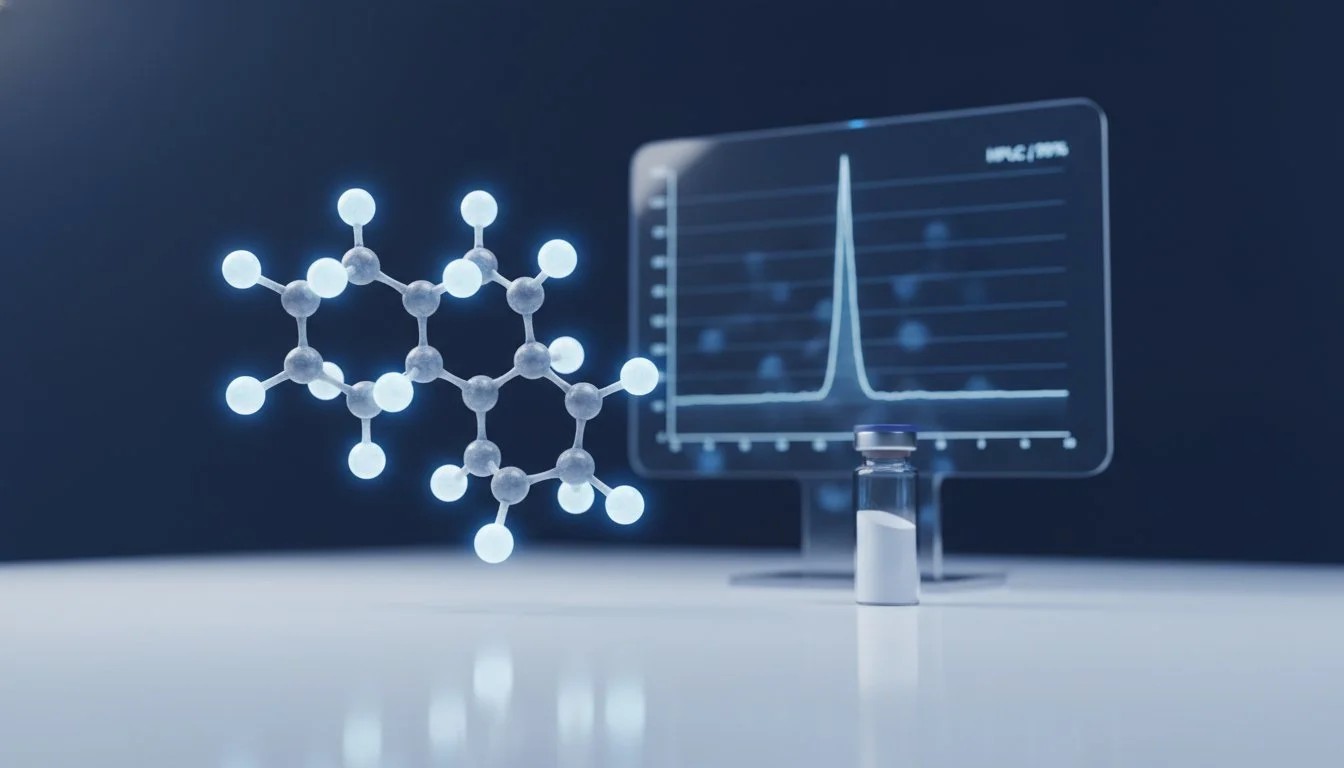
HPLC is the primary instrument used to calculate the purity percentage. It works by passing the peptide through a column under high pressure, separating molecules based on their specific chemical interactions. The results are visualized as a chromatogram.
- The Main Peak: This is the most prominent spike on the graph. It represents the target peptide sequence being measured.
- Area Under the Curve (AUC): The 99% figure is mathematically derived from the AUC. Technicians calculate the area of the main peak relative to the total area of all detected peaks. If the main peak accounts for 99% of the total integrated area, the sample achieves that purity grade.
- Noise vs. Impurities: A professional report distinguishes between baseline “noise,” which is electronic interference, and actual impurities. Distinct smaller peaks indicate specific peptide-related contaminants that must be accounted for in the final purity calculation.
Mass Spectrometry: Confirming Peptide Identity
HPLC measures how much of the “main” substance is present, but Mass Spectrometry confirms what that substance actually is. It measures the mass-to-charge ratio of the ionized molecules to determine their exact weight. This step is critical because it’s possible to have a 99% pure sample of the wrong peptide if identity is not verified. MS allows researchers to match the observed mass to the theoretical molecular weight of the peptide. It also detects “isobaric” impurities that HPLC might occasionally miss, ensuring the lyophilized powder contains exactly what the label specifies. This rigorous process eliminates the risk of using misidentified compounds in your investigations.
Nexa Peptide Store mandates third-party testing to verify these metrics independently. This commitment to transparency ensures that when you order research peptides for your laboratory, the data on the COA is backed by objective, high-resolution analysis. Every batch undergoes this dual-verification process to maintain an uncompromising stance on product integrity and operational protocols.

Purity vs. Net Peptide Content: The 5% Misconception
A common point of confusion in laboratory procurement is the distinction between purity and net peptide content. While purity quantifies the homogeneity of the peptide chains, net peptide content (NPC) measures the total percentage of peptide by weight. Most lyophilized vials contain between 10% and 30% non-peptide components, which include moisture and residual salts from the manufacturing process. Failing to recognize this difference leads to significant errors in molar calculations, even when you strictly follow what does 99 percent peptide purity mean in a technical report.
Understanding what does 99 percent peptide purity mean requires distinguishing between the molecular population and the physical weight of the sample. Purity is a measure of quality, whereas net peptide content is a measure of quantity. If your experimental protocol requires a specific molar concentration, relying solely on the purity percentage will result in an under-dosed solution.
The Role of Counter-Ions and TFA
Peptides are typically unstable in their free-base form. To maintain structural integrity and solubility, they’re provided as salts, usually acetate or trifluoroacetic acid (TFA). TFA is an essential byproduct of the reverse-phase HPLC purification process. These counter-ions contribute significantly to the total mass of the lyophilized powder. It’s a scientific reality that 99% purity can coexist with 80% net peptide content. This discrepancy occurs because the purity percentage only accounts for peptide-related impurities, while the TFA salt is a non-peptide additive.
Accounting for Moisture in Lyophilized Vials
Lyophilization, or freeze-drying, is the standard method for removing water and solvents after synthesis. While this process is highly efficient, it doesn’t result in a 100% dry product. High-grade research chemicals typically retain residual moisture levels between 1% and 8%. This moisture adds weight to the vial without contributing to the peptide’s concentration. Proper storage in a desiccated environment is critical to prevent post-shipment moisture absorption, which could further dilute the net content.
Precise reconstitution depends on knowing the actual peptide mass. When using a peptide calculator for laboratory research, you must account for the net peptide content to achieve the desired molarity. Relying solely on the purity percentage will result in a solution that’s less concentrated than intended, potentially skewing your experimental outcomes and compromising the integrity of your data.
The Impact of Impurities on Laboratory Research Outcomes
The presence of impurities in a research sample introduces a layer of chemical noise that can compromise the most rigorous experimental designs. When a researcher asks what does 99 percent peptide purity mean in the context of outcome reliability, the answer lies in the elimination of unknown variables. A sample with 95% purity contains 5% of unintended substances. These are not inert fillers. They’re often truncated or deleted sequences that function as structural analogs to the target peptide. Understanding what does 99 percent peptide purity mean is the first step toward securing the institutional trust required for high-impact publication.
These contaminants can competitively inhibit the target peptide’s interaction with specific receptors. Because these “near-miss” molecules often share similar binding motifs, they may occupy receptor sites without triggering the intended biological response. This blocking effect leads to an underestimation of the peptide’s true potency. In other cases, impurities may exhibit unexpected cellular toxicity. This masks the actual effect of the research compound and potentially leads to the premature abandonment of a viable hypothesis. For sensitive assays such as Nuclear Magnetic Resonance (NMR) or X-ray crystallography, high purity is non-negotiable. These techniques require extreme molecular homogeneity to produce clear, interpretable structural data.
Reproducibility and Data Integrity
Data reproducibility is the foundation of institutional credibility. Batch-to-batch variance in purity levels can ruin long-term longitudinal studies, as the “noise” introduced by contaminants changes with every new shipment. Failed experiments due to poor material quality result in the loss of significant institutional resources and grant funding. Maintaining a 99% purity standard ensures that your findings remain eligible for peer-reviewed publication. It removes the ambiguity that often plagues studies conducted with lower-grade materials.
Addressing Objections: Is 99% Always Necessary?
Different research stages require different standards. Screening-grade materials, roughly 80% purity, are sometimes used for initial high-throughput tests. Research-grade chemicals (95%+) are common in general laboratory work. However, the highest tier, high-purity (99%+), is essential for definitive investigations. Nexa Peptide Store focuses exclusively on this top tier to ensure that every compound, even complex molecules like retatrutide peptide, provides the most accurate data possible. Triple-agonist peptides like retatrutide require precise folding and sequence integrity to interact correctly with multiple receptor pathways simultaneously.
To ensure your next investigation is backed by this level of precision, you can buy high-purity peptides from our verified catalog.
Nexa Peptide Store: Commitment to ≥99% Purity Standards
Nexa Peptide Store maintains a rigorous standard for all chemical offerings. We strictly supply compounds with a verified purity level of at least 99%. While previous sections detailed what does 99 percent peptide purity mean from a chemical standpoint, our operation translates that metric into a logistical reality. Every batch’s subjected to comprehensive HPLC and Mass Spectrometry testing before it’s approved for distribution to the scientific community. This dual-layered verification process ensures that the chromatographic homogeneity of our products meets the exacting demands of modern molecular biology. Understanding what does 99 percent peptide purity mean in a procurement context is essential for researchers who value data integrity over marketing claims.
All products distributed by Nexa are strictly for research use only. They aren’t intended for human or veterinary consumption. This clear boundary’s a core component of our professional identity and ensures that our operations remain compliant with the strictest regulatory frameworks. By providing researchers with the precision they require for in vitro investigations, we position ourselves as a peer to the academic and independent organizations we serve. It’s a relationship built on technical trust and the consistent delivery of high-resolution compounds.
Our Quality Control Protocol
Our protocol begins with sourcing from established manufacturing partners who operate under stringent environmental controls. We prioritize stability, ensuring that each compound maintains its structural integrity during international shipping through optimized environmental safeguards. This level of oversight’s particularly critical when analyzing complex molecular interactions, such as the Tirzepatide mechanism of action or other multi-pathway research compounds. By verifying every batch post-production, we eliminate the uncertainty often found in lower-tier supply chains. Our commitment to quality control doesn’t waver, reflecting a history of operational discipline that prioritizes the needs of the laboratory over commercial convenience.
Procurement for Research Institutions
We support a global network of universities and independent laboratories that require bulk verification and transparent quality control data. The Nexa guarantee centers on precision, transparency, and scientific reliability in every vial. We recognize that institutional credibility depends on the quality of the starting materials. Therefore, we provide the comprehensive documentation necessary for institutional procurement, ensuring that your laboratory has the verifiable proof points required for high-level research. This transparency allows for the seamless integration of our products into established experimental workflows, providing a foundation for reproducible and peer-reviewable data.
Explore our full catalog of 99% pure research peptides to secure the high-resolution materials necessary for your next investigation.
Advancing Research Through Analytical Precision
Achieving reproducible experimental data requires a comprehensive grasp of your material’s chemical profile. We’ve established that 99% purity represents the population of correct peptide sequences, yet it must be balanced against net peptide content to ensure accurate molarity. By distinguishing between chromatographic homogeneity and the physical mass of the vial, researchers can eliminate the unknown variables that frequently compromise long-term studies. Understanding what does 99 percent peptide purity mean is not just a technical requirement; it’s a foundational step in maintaining the integrity of your laboratory investigations and securing peer-reviewed results.
Nexa Peptide Store remains a dedicated partner to global research organizations, offering over 100+ peptides verified at the 99% purity threshold. Every batch is third-party lab tested with a comprehensive COA available to ensure absolute transparency and operational discipline. This commitment to quality control allows you to focus on your findings rather than questioning the stability of your compounds. We invite you to utilize our rigorous standards to elevate your scientific output. Secure High-Purity Peptides for Your Next Investigation and ensure your data remains beyond reproach.
Frequently Asked Questions
Is 99% peptide purity the same as 100%?
No, 100% purity is a theoretical ideal that’s practically unachievable in synthetic chemistry. A 99% rating indicates that 1% of the sample consists of peptide-related impurities, such as deletion or truncated sequences. Even the most sophisticated purification processes leave trace residues of non-target molecules, making 99% the highest realistic standard for laboratory research.
Can a peptide be 99% pure but have low net peptide content?
Yes, this is a common occurrence in lyophilized products. While the purity percentage measures the homogeneity of the peptide chains, the net peptide content accounts for the total weight, which includes moisture and counter-ions like TFA salts. You’ll often find that a vial with 99% purity actually contains only 70% to 85% peptide by total mass.
Why do some peptides only come in 95% or 98% purity?
Certain amino acid sequences are inherently difficult to synthesize or purify due to their hydrophobic nature or extreme length. For screening-grade work or initial assays, 95% is often acceptable; however, for definitive molecular research, 99% remains the gold standard. Understanding what does 99 percent peptide purity mean is vital for selecting the appropriate grade for your specific experimental requirements.
How do I verify the purity of the peptides I purchased?
Verification requires reviewing the provided Certificate of Analysis (COA) for High-Performance Liquid Chromatography (HPLC) and Mass Spectrometry (MS) data. The HPLC chromatogram shows the “Main Peak” and the integrated area under the curve, which confirms the purity percentage. Mass Spectrometry verifies the molecular weight, ensuring the identity of the compound matches the intended sequence exactly.
Does the purity level affect the shelf life of the peptide?
High purity generally improves stability because there are fewer reactive impurities to catalyze degradation. Contaminants like oxidized residues or residual solvents can accelerate chemical breakdown over time. Maintaining a 99% standard ensures that the peptide remains stable during long-term storage in a desiccated, sub-zero environment, protecting the integrity of your stock.
What happens if a peptide has less than 99% purity in a lab setting?
Lower purity introduces unknown variables that can compromise data reproducibility and lead to false-positive results. Impurities may competitively inhibit receptor binding or cause unintended cellular toxicity, masking the true biological effect of the target sequence. This is exactly why researchers ask what does 99 percent peptide purity mean when trying to ensure the integrity of sensitive assays.
Are Nexa peptides suitable for clinical trials in humans?
No, Nexa peptides are strictly for laboratory research use only. Our products aren’t intended for human or veterinary consumption and don’t carry pharmaceutical-grade certifications for clinical use. We provide high-purity chemicals to support in vitro and in vivo research within academic and independent laboratory settings, maintaining clear boundaries regarding regulatory compliance.
What is the difference between research-grade and pharmaceutical-grade purity?
Research-grade focuses on chemical purity and identity for laboratory investigations, whereas pharmaceutical-grade requires additional cGMP manufacturing standards, including sterility and pyrogen testing. While research peptides often meet or exceed 99% purity, they lack the specific regulatory filings and clinical-grade processing required for human therapeutic applications. We focus exclusively on the research-grade tier for institutional procurement.
